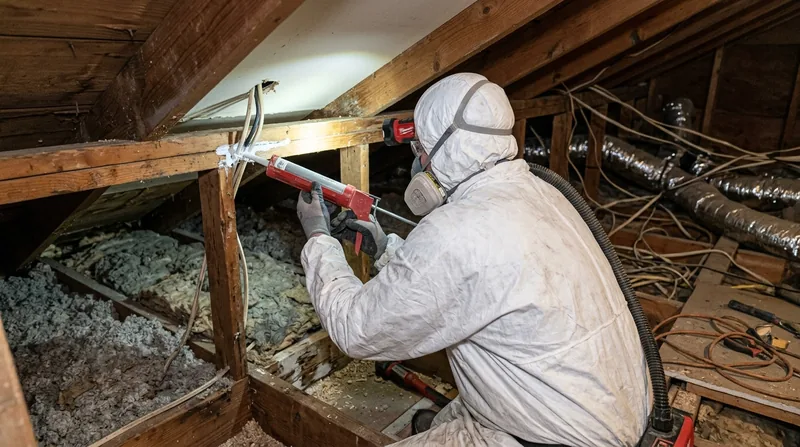




Cedar Rapids homes lose more heat through the ceiling plane and rim joists than anywhere else in the building envelope, especially during the long Iowa winters. The mix of early-1900s houses near downtown and Czech Village, postwar ranches in Marion and Hiawatha, and newer subdivisions all sit over basements rather than crawl spaces, which means air sealing in Cedar Rapids targets the exact spots where warm, moist indoor air escapes into cold framing and condenses. This is IECC climate zone 5A, and when the heating season pushes moisture outward through the building envelope, air leaks at the top plate and band joists do the most damage. We use foam and caulk at penetrations, top plates, and rim joists common to Linn County basements and attics. The result is lower heating bills, fewer cold floors, and a more comfortable home from October through April. Learn more about our full range of spray foam solutions on our homepage.
Why Air Sealing Matters in Cold Climates Like Cedar Rapids
Air leaks at the ceiling plane and rim joists are the primary source of heat loss in Cedar Rapids homes. A single 1-inch gap at the top plate of an exterior wall can bleed as much heat as an open window, and in a basement rim joist that gap might be 10 or 20 feet long. The 2008 flood and 2020 derecho forced many Cedar Rapids homeowners to rebuild or renovate, which often left a patchwork of original wall cavities and newer framing in the same structure. That inconsistency amplifies the problem: old homes have uninsulated top plates and settling that opens new gaps, while postwar ranches carry vented attics that leak heat through every penetration and recessed light. The Iowa State University Extension and Outreach office confirms that air sealing the ceiling plane is the single highest-return insulation investment in climate zone 5A.
- We seal the top plates where exterior walls meet the attic or roof cavity using closed-cell foam and caulk.
- We air-seal rim and band joists at the basement level, where the cold basement wall meets the heated floor above.
- We caulk and foam around electrical penetrations, HVAC chases, and plumbing stacks that pierce the ceiling plane.
- We identify and seal gaps in the thermal barrier that fiberglass or blown-in insulation alone cannot reach.
These four steps cut the heating load that your furnace must carry all winter long.
Key info: Cedar Rapids homes built before 1970 often have flattened or missing insulation above the top plates, especially in older neighborhoods along the Cedar River and in Czech Village. The 2008 flood and 2020 derecho damage left many homes with partial rebuilds, which means the ceiling plane is now a patchwork of sealed and unsealed sections. Air sealing closes those gaps before you add any new insulation on top.
For the full regulatory context in your city, check the Cedar Rapids Building Department website to confirm what permits and inspections apply to air sealing work at your address.
How We Air-Seal Homes in Cedar Rapids: Step by Step
Air sealing is a precision job. We start with a blower-door test or a visual walk-through to locate the biggest leaks, then we prioritize the ceiling plane and rim joists where the heat loss is greatest. We use closed-cell foam at band joists and rim joists because the basement is cold and humid, and closed-cell resists moisture. At the ceiling plane, we use open-cell foam at top plates where the attic is vented, or closed-cell if the attic is sealed or conditioned. The key is controlling the thickness on each pass (never more than 1 inch at a time) and maintaining the correct spray ratio and drum temperature so the foam cures properly. We run mechanical ventilation during cure and specify a re-entry window of 24 to 48 hours. After cure, we caulk any remaining gaps with elastomeric sealant. This layered approach stops the air leak without trapping moisture or creating a safety hazard.
- We inspect the attic and basement to identify all air leaks at the ceiling plane, rim joists, and penetrations.
- We seal the substrate, check for moisture, and confirm the attic or basement is ready for foam.
- We spray foam in controlled passes, never exceeding 1 inch thickness per application.
- We run mechanical ventilation and post a re-entry sign; you stay out for 24 to 48 hours.
- We trim excess foam and caulk any remaining gaps with elastomeric sealant.
- We inspect the finished work and provide you with written documentation of R-value and thickness.
The whole process typically takes one to three days, depending on the size of the area and the complexity of the rim joists or attic layout.
Real example: A 1970s ranch in Marion with a basement rim joist that runs 80 feet around the foundation, plus an open attic above the living spaces. We sealed the rim joist with 2 inches of closed-cell foam (R-13), then air-sealed the attic ceiling at the top plates and around a recessed light fixture with open-cell foam and caulk. Total time: two days. The homeowner reported noticeably warmer floors and a quieter basement within one month.
For more information on how foam insulation complements air sealing, see our guide to attic spray foam insulation in Cedar Rapids.
Air Sealing Methods and Materials
| Approach | Description | Best for |
|---|---|---|
| Closed-cell foam at rim joists | 2-inch layer of closed-cell polyurethane, R-13 per inch, moisture-resistant and rigid. | Cold, humid basements in Cedar Rapids; band joists and rim joists where moisture is a concern. |
| Open-cell foam at ceiling plane | 2-inch layer of open-cell polyurethane, R-3.6 per inch, softer and vapor-permeable. | Vented attics and top plates where the attic is not conditioned; sound dampening is a bonus. |
| Elastomeric caulk | Polyurethane or acrylic caulk applied by gun to seal gaps smaller than 1 inch. | Electrical penetrations, plumbing chases, and the edges of foam joints after trim. |
| Closed-cell foam at sealed attics | 2-inch closed-cell at the roof deck or ceiling plane when the attic is conditioned and sealed. | Newer homes in Hiawatha or Marion with sealed attics; prevents condensation on cold roof decks. |
Each material and thickness is selected based on the location, moisture risk, and whether the attic or basement is vented or sealed. We write it all down: R-value, thickness, and location.
Air Sealing Cost in Cedar Rapids: What to Expect
The cost of air sealing in Cedar Rapids depends on the size of the area, the number of penetrations, and whether you are sealing the attic ceiling plane, rim joists, or both. A typical rim joist air-sealing job on a single-story home in Cedar Rapids or Marion starts at $650 and covers approximately 30 to 40 linear feet of band joist with 2 inches of closed-cell foam. An attic ceiling plane seal on a 1,500-square-foot ranch might run $800 to $1,200, depending on the number of recessed lights, HVAC penetrations, and the complexity of the framing. A combined rim joist and attic air-seal on a larger home in Hiawatha or Robins can reach $1,500 to $2,500. The main factors that move the price are the linear footage of rim joist, the square footage of attic ceiling to seal, the number of mechanical penetrations, and accessibility. If your attic is cluttered with old insulation or your basement has low headroom, the job takes longer and costs more.
We always recommend getting a written estimate that includes the R-value, thickness, and square footage or linear footage of each area. Never accept a price without those details. You should also get two or three estimates from different contractors so you can compare apples to apples. Visit our pricing page for a full breakdown of our rates and what drives them up or down.
Travel to Cedar Rapids, Marion, Hiawatha, Robins, and surrounding areas is included in our estimate; there is no separate mileage fee. Call us at (319) 774-1583 for a free, no-obligation estimate. We respond within 24 hours.
Air Sealing Near Me: What Cedar Rapids Homeowners Should Know When Hiring a Contractor
Air sealing is a small job by dollar value, but it is a high-skill trade. A bad air-sealing job looks fine from the outside but leaves gaps that bleed heat all winter. When you are looking for an air-sealing contractor near Cedar Rapids, look for these red flags and green flags. First, get a written estimate that names the R-value, thickness, and location of every foam or caulk application. If the estimate is just a lump sum with no details, walk away. Second, ask whether the contractor will run mechanical ventilation during cure and what re-entry window they promise. The correct answer is 24 to 48 hours with mechanical ventilation running. If they say you can re-enter in 4 hours or that ventilation is not needed, they are cutting corners. Third, verify that the contractor is fully insured and ask for a certificate of insurance. You can also ask whether they carry a workmanship warranty; we offer one year on the installation. Fourth, do not be afraid to ask for references from homes in Cedar Rapids or Marion where they have done air sealing work. Fifth, check whether your HOA or city permits require notification before you start. Most air-sealing jobs in Cedar Rapids do not need a permit, but attic work in some neighborhoods or sealed-attic conversions might. Call the Cedar Rapids Building Department at (319) 286-5794 to confirm what applies to your address.
- Get a written estimate with R-value, thickness, and location details before you commit to any contractor.
- Confirm that the contractor will run mechanical ventilation during cure and specify a 24 to 48-hour re-entry window.
- Ask to see proof of insurance and request a certificate of insurance before work begins.
- Check whether your city or HOA requires a permit or notification for attic or basement air-sealing work.
- Call the Cedar Rapids Building Department to verify what regulations apply to your specific address and the work scope.
If you have any questions about our process, our insurance, or what to expect, call us at (319) 774-1583 or request a free estimate online. We are happy to answer your questions and walk you through the whole process.
Air Sealing in Cedar Rapids: Pricing Guide
| Service | Price | Details |
|---|---|---|
| Rim joist air sealing (30-40 linear feet) | Starting at $650 | Closed-cell foam at band joist, 2 inches, includes caulk and trim for single-story basement |
| Attic ceiling plane air sealing (1,000-1,500 sq ft) | Starting at $800 | Open-cell foam at top plates and penetrations, caulk and trim, vented attic configuration |
| Combined rim joist and attic air sealing | Starting at $1,400 | Full basement rim joist plus attic ceiling plane on ranch or two-story home, includes both foam types |
| Complex or large-scale job | On estimate | Multiple basements, sealed attics, extensive penetrations, or cluttered attic space requires on-site inspection |
| Travel | Included | No separate mileage fee within Cedar Rapids, Marion, Hiawatha, Robins, and surrounding service area |
| Estimate | Free | Written estimate with R-value and thickness specs, response within 24 hours, no obligation to book |
Indicative pricing, the exact cost depends on square footage, finish, and site access. Free personalized estimate within 24h at (319) 774-1583.


