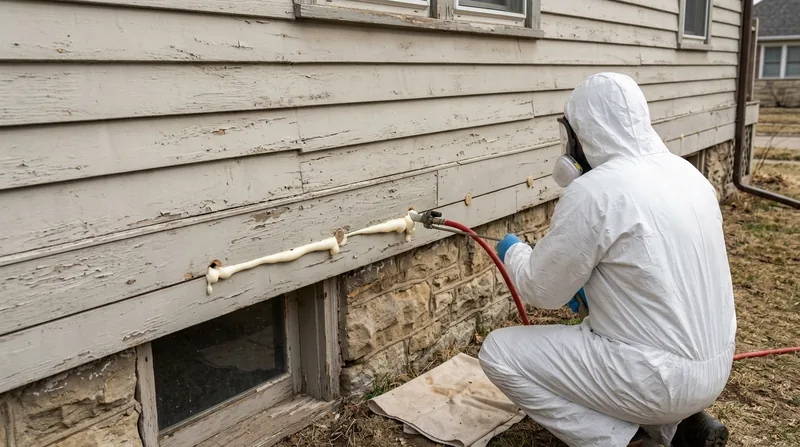




Wall and injection foam insulation in Cedar Rapids fills the closed cavities of older homes without tearing into plaster or siding. Cedar Rapids' early-1900s housing stock, concentrated near Czech Village and NewBo, sits in IECC climate zone 5A with hard winters and outbound moisture drive during heating season. Injection foam raises the R-value of original stud cavities while preserving the historic character of walls that have stood for more than a century. This is retrofit insulation for homes where opening walls is not an option, whether for cost, aesthetics, or structural integrity. If you own a pre-1980 house in Cedar Rapids or Marion and your heating bills climb every winter, injection foam may be the answer that does not require siding removal or interior demolition.
Why Wall and Injection Foam Matters in Cedar Rapids Older Homes
Original wall cavities in Cedar Rapids homes built before 1950 were often left empty or filled with sawdust, newspaper, or low-density material that has settled and lost its thermal value over seventy years. The 2008 flood and 2020 derecho forced many homeowners to rebuild sections of their walls, but the rest of the house stayed original. When you have a mix of new framing alongside original cavities in the same wall, energy loss is uneven and drafts are hard to pinpoint. Injection foam fills those voids completely without opening the wall to the weather or the interior, and it does not require the ventilation and cure time that spray foam applied to open studs demands.
- Injection foam seals closed cavities in plaster and siding without demolition or disturbance to the interior finish.
- The process adds R-value to stud bays that have settled insulation or none at all, raising the thermal envelope of the whole wall.
- Injection ports are small and can be patched invisibly on either the interior or exterior, depending on access and finish.
- This method works in historic homes where exterior cladding or interior plaster must remain intact for character or code compliance.
- Older homes in Cedar Rapids often show cold spots on exterior walls in winter, a sign that cavities are under-insulated or empty.
Injection foam is the retrofit solution for walls that cannot be opened, and it is especially valuable in Cedar Rapids because so many homes here span more than a century and sit in a climate where heating loss through walls is a year-round cost.
Key info: A home in Cedar Rapids built in 1915 near the Cedar River may have original 2x4 walls with no insulation. Injection foam fills those cavities to R-13 or R-15 without opening the plaster. A 1,200 sq ft first floor wall on the north side can gain 10 to 15 percent of its winter heat retention, a measurable difference in a zone 5A climate.
How We Perform Wall and Injection Foam Insulation in Cedar Rapids
Injection foam work begins with a site assessment to identify which cavities are empty or under-filled and to locate utilities and structural elements. We drill small access holes (typically 1.5 inches or less) on a grid pattern, usually on the exterior where they can be patched to match siding, or on the interior if exterior access is blocked. Once holes are positioned, we inject low-pressure, low-VOC foam that expands to fill the cavity completely, curing in place without requiring mechanical ventilation during application. The process is quieter and faster than open-cell spray foam and leaves no odor once cured. After foam sets, we patch the injection ports with matching plugs or caulk.
- We conduct a detailed inspection to map cavity locations, identify obstructions, and plan injection port placement.
- We drill small access holes on a grid, typically spaced 16 to 24 inches apart, depending on wall height and cavity depth.
- We inject foam at controlled pressure and temperature, monitoring density and fill to ensure complete cavity coverage without over-pressurization.
- We allow the foam to cure per manufacturer specification, typically 24 to 48 hours before patching injection ports.
- We patch all injection holes with foam-compatible plugs or caulk, finishing to match the existing wall surface.
This step-by-step approach ensures complete fill without damaging the wall structure or the finish on either side.
Example: A 1920s home in Marion with two-story brick and plaster walls on the north and west exposures can be injected from the exterior without disturbing the interior plaster. We drill from outside, inject foam to fill the 3.5-inch stud cavities, and patch the exterior brick with matching mortar. The homeowner sees no interior work, and the wall gains 10 to 15 points of R-value.
For more information on how injection foam fits into a broader air sealing strategy, see our air sealing service page.
Injection Foam Methods and Materials
| Method | Description | Best For |
|---|---|---|
| Low-pressure injection foam | Closed-cell or open-cell foam injected at 2 to 4 PSI through small ports, expanding to fill cavities without pressure damage to the wall. | Historic homes, plaster walls, cavities with existing settling, retrofit work where walls must stay intact. |
| High-density injection (closed-cell) | Denser foam formula, R-6 per inch, injected into cavities to create a moisture barrier and air seal in one application. | Zone 5A cold climates where outbound moisture during heating season is a concern, and where cavities touch basement walls or rim joists. |
| Low-density injection (open-cell) | Lower-density foam, R-3.5 per inch, softer and easier to cut or drill through if future work is needed, less expensive per board foot. | Interior walls where future wiring or plumbing changes are likely, sound dampening, and retrofit budgets where R-value is secondary to air sealing. |
| Cavity-fill assessment and removal | We inspect cavities before injection, remove settled or damaged insulation if present, and clean debris to ensure foam bonds properly. | Older Cedar Rapids homes where cavities contain sawdust, mineral wool, or failed fiberglass that must be cleared before new insulation is added. |
Each method is selected based on the cavity depth, the wall exposure, the existing condition, and the homeowner's R-value and moisture-control goals. We provide written estimates that specify the R-value, the foam type, the board-foot volume, and the thickness once cured.
Wall and Injection Foam Insulation Cost in Cedar Rapids: What to Expect
Injection foam insulation in Cedar Rapids typically starts at $2 per square foot of wall cavity treated, with most residential retrofit jobs landing between $2.50 and $4.50 per square foot depending on access, cavity depth, and foam type. A 1,500 sq ft wall section with accessible exterior ports and standard 3.5-inch cavities may cost $3,750 to $6,750 including labor, materials, and port patching. Jobs that require interior drilling, tight access, or removal of settled insulation before injection run higher because of the time and complexity involved. Travel within Cedar Rapids, Marion, Hiawatha, and surrounding areas is included in our estimate; there is no separate mileage charge.
The best way to understand cost for your specific home is to get a written estimate that includes the square footage of wall cavity, the R-value target, the foam type, and the board-foot volume. We provide estimates at no charge within 24 hours of your call. For a detailed pricing overview across all our services, visit our pricing page.
Factors that move cost up or down include the following: exterior access (easier and cheaper if we can drill from outside), cavity depth (2x4 studs versus 2x6 studs), presence of existing insulation or debris that must be cleared, and the foam type you choose. Closed-cell foam costs more per board foot but delivers higher R-value per inch and a vapor barrier in one step. Open-cell foam is less expensive and works well for interior walls where future changes are likely. Call (319) 774-1583 to schedule a free estimate and get a firm number for your home.
Wall and Injection Foam Insulation Near Me: What Cedar Rapids Homeowners Should Know When Hiring
Hiring the right spray foam contractor is the single most important decision in any insulation project. The difference between a professional installation and a rushed or poorly executed job shows up in the smell, the cure time, the quality of patching, and whether the cavities are actually filled. When you call a contractor for an estimate, ask specific questions and watch for red flags that signal a rig-and-run operation or a contractor who cuts corners.
A reputable spray foam contractor will provide a written estimate with R-value and thickness specified, not a vague per-board-foot quote with no details. They will explain what permits apply at your address by referring to the local building department (permitting and contractor registration vary from city to city across Greater Cedar Rapids, and there is no reciprocity). They will tell you how long the foam takes to cure and when you can safely re-enter the space. They will carry full insurance and provide a certificate of insurance on request. They will not promise immediate re-entry or a same-day finish; proper cure takes 24 to 48 hours depending on temperature and humidity.
Check references from recent jobs in Cedar Rapids, Marion, or Hiawatha. Ask whether the contractor has handled historic homes or plaster walls before, because technique and materials differ from new construction. If your home is in an HOA or a historic district, verify that exterior work like drilling and patching complies with architectural guidelines. Ask the contractor to explain how they will patch the injection ports to match your siding or brick. For a free estimate and to discuss your specific wall, contact us or call (319) 774-1583.
You can also verify any contractor's insurance status and ask whether they are registered with the state or local building department. The key is to get at least two estimates, compare the R-value and coverage in writing, and choose the contractor who explains the work clearly and stands behind it with a warranty. Our homepage lists the cities we serve and the services we offer; if you are in Cedar Rapids, Marion, Hiawatha, Robins, or the surrounding area, we are ready to help.
Wall & Injection Foam Insulation in Cedar Rapids: Pricing Guide
| Service | Price | Details |
|---|---|---|
| Injection foam, standard residential wall | Starting at $2/sq ft | Low-pressure foam fill for 3.5-inch cavities, exterior access, standard patching included |
| Injection foam with cavity cleanup | Starting at $3/sq ft | Removal of settled or damaged insulation before injection, adds labor but ensures complete cavity fill |
| Interior drilling or tight-access jobs | Starting at $3.50/sq ft | Interior ports, interior patching, or constrained access that requires extra setup time and care |
| High-density closed-cell injection | Starting at $4/sq ft | Closed-cell foam, R-6 per inch, moisture barrier included, higher cost than open-cell for superior performance |
| Complex or large retrofit | On estimate | Jobs exceeding 3,000 sq ft of cavity, mixed wall types, or historic restoration requiring specialized technique |
| Free estimate and site visit | No charge | Response within 24 hours, written quote with R-value and thickness, no obligation to book |
Indicative pricing, the exact cost depends on square footage, finish, and site access. Free personalized estimate within 24h at (319) 774-1583.


