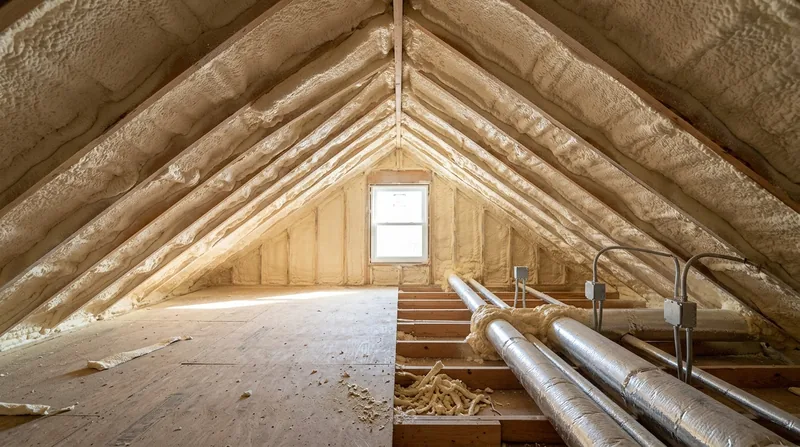




Attic Spray Foam Insulation in Cedar Rapids stops heat loss through the roof deck and seals air leaks that older homes in downtown, Czech Village, and NewBo neighborhoods lose money through every winter. Cedar Rapids attics in homes built before 1980 often have flattened or missing insulation above the top plates, while postwar ranches and newer builds in Marion and Hiawatha carry vented attics that still leak heat through recessed lights, exhaust penetrations, and poorly sealed rim board connections. This is IECC climate zone 5A with hard winters and outward moisture drive during the heating season, meaning warm indoor air escapes into cold framing where it condenses and causes rot. Spray foam closes those air paths and delivers continuous R-value without gaps, making it the most effective retrofit for the attic floor or sealed roof deck. We air-seal penetrations, spray the deck or joist cavity to your R-value target, and help you navigate permitting so the work meets your local building code.
Why Attic Spray Foam Insulation Matters in Cold Cedar Rapids Winters
Heating bills, not cooling, drive most insulation decisions in Cedar Rapids and Linn County. The failure mode that dominates here is heat loss through the ceiling plane and air leakage at the attic floor, especially where older framing meets newer additions and where rim board meets the top plate of basement walls. A single recessed light fixture or an unsealed exhaust penetration in an attic floor acts like a chimney, pulling warm air out of your living space and pushing cold air back down through the walls. Spray foam stops this cycle by sealing every gap and delivering continuous insulation with no thermal bridges. Most homeowners notice the difference first in cold floors over basements and drafty rim joists, but the attic is where the biggest heat loss happens.
- We identify all air leaks around penetrations, light fixtures, and the rim board where the attic meets the wall.
- We spray closed cell or open cell foam to your target R-value, measured in inches and board feet on site.
- We air-seal the attic floor or roof deck so warm indoor air stays in your home and moisture does not condense in the framing.
- We help you understand what your local building code requires for ventilation, ignition barriers, and thermal barriers so the job passes inspection.
The result is lower heating bills, no cold drafts, and a drier attic that protects the roof structure from rot and decay.
Key info: Cedar Rapids homes near the Cedar River rebuilt or renovated after the 2008 flood and 2020 derecho often have a mix of original wall cavities and newer framing in the same structure. Spray foam retrofit closes air leaks between old and new sections, which is where the worst heat loss happens. Contact your local building department to confirm whether your attic needs ventilation or can be sealed as an unvented (conditioned) space, because the answer changes the foam type and thickness.
For more information on how spray foam seals the building envelope, see our air sealing service page.
How We Spray Foam Your Cedar Rapids Attic: Step by Step
Every attic is different. Older homes in downtown Cedar Rapids may have no insulation above the top plates, while a 1970s ranch in Marion might have settled fiberglass and no air sealing. We start with a walk-through to measure the attic floor, identify penetrations, and check for moisture, active leaks, or contamination. If the substrate is wet, moldy, or contaminated, we stop and refer you to the appropriate specialist. If the attic is sound, we remove old insulation if needed, air-seal the penetrations and rim board, then spray foam to your R-value target. We control the foam application with proper equipment calibration, drum temperature, and mechanical ventilation during cure, and we provide a re-entry window of 24 to 48 hours before normal use.
- We inspect the attic for moisture, active leaks, contamination, and structural soundness before any work begins.
- We remove old, flattened, or failed insulation and dispose of it responsibly if your scope includes removal.
- We air-seal all penetrations, rim board connections, and attic access doors with closed cell or open cell foam.
- We spray the attic floor or roof deck to your target R-value, measured in board feet and thickness per pass.
- We run mechanical ventilation during cure and provide a written re-entry window so you know when the attic is safe to occupy.
The whole process protects your roof structure, stops drafts, and lowers your heating bill without disrupting your home.
Example: A 1960s ranch in Hiawatha with an open-cell insulation retrofit had recessed lights, bathroom exhaust, and a kitchen soffit that were not sealed. We removed the settled fiberglass, air-sealed all penetrations with closed cell foam, and sprayed the floor to R-38. The homeowner reported no more cold drafts, and the heating bill dropped noticeably. See our insulation removal page for details on the precondition work.
Attic Spray Foam Methods: Closed Cell vs. Open Cell in Cedar Rapids
| Approach | Description | Best for |
|---|---|---|
| Closed Cell Spray Foam | Dense, rigid foam with small closed cells. R-value approximately 6.5 to 7.0 per inch. Acts as a vapor barrier and moisture control layer. Requires 15-minute thermal barrier or ignition barrier per code. | Sealed (unvented) roof decks, attics where moisture control is critical, and homes where you want the lowest thickness for a given R-value. |
| Open Cell Spray Foam | Light, spongy foam with open cells that allow vapor transmission. R-value approximately 3.5 to 3.8 per inch. Does not act as a vapor barrier. Typically requires thicker application but costs less per board foot. | Vented attics where vapor can escape, sound dampening, and budget-conscious retrofits where thickness is not a constraint. |
| Attic Floor Spray (Both Types) | Foam applied directly to the attic floor joists, sealing the ceiling plane and all penetrations. Stops warm air from rising into the attic and eliminates cold drafts into living spaces below. | Vented or unvented attics where the goal is to seal the conditioned space from the unconditioned attic above. |
| Sealed Roof Deck Spray | Foam applied to the underside of the roof sheathing, making the attic part of the conditioned space. Requires closed cell foam for moisture control. Ventilation is eliminated, and the attic becomes usable living or storage space. | Homes with knee walls, finished attic spaces, or where you want to reclaim attic volume as conditioned space. |
The choice between closed cell and open cell depends on your building envelope design and your local code. Cedar Rapids homes in climate zone 5A with hard winters and humid summers benefit from closed cell foam in sealed roof decks because it controls moisture on the warm side of the insulation during the heating season. Vented attics can use either type, but open cell is lighter to apply and costs less. We specify the foam type and thickness in writing before we start, so you know exactly what you are getting and why.
Attic Spray Foam Insulation Cost in Cedar Rapids: What to Expect
Attic spray foam insulation in Cedar Rapids typically starts at $1.50 per square foot for straightforward applications with good access and standard R-values. The final cost depends on several real factors: the size of the attic floor, the target R-value, whether you need old insulation removed first, the number and type of penetrations to air-seal, and the foam type (closed cell costs more per board foot than open cell). A typical 1,200-square-foot attic retrofit with removal and air sealing runs $1,800 to $3,200 depending on complexity and foam choice. Sealed roof decks cost more because they require closed cell foam and thicker application, often $2.50 to $3.50 per square foot. Getting 2 to 3 written estimates with R-value and thickness specifications is the only way to compare fairly, because price per board foot without context is meaningless.
We provide a free, no-obligation written estimate within 24 hours at (319) 774-1583. Our estimate includes the attic dimensions, target R-value, foam type, expected board feet, and the scope of air sealing and removal. See our full pricing page for detailed ranges and examples by service type.
Cost factors: An older Cedar Rapids home with many roof penetrations, recessed lights, and flattened insulation costs more to retrofit than a newer Hiawatha ranch with simple framing. If you need insulation removal first, add $0.50 to $1.00 per square foot for labor and disposal. Travel within Cedar Rapids and surrounding areas is included with no separate mileage charge.
What to Look for When Hiring a Spray Foam Insulation Contractor Near Cedar Rapids
The spray foam insulation trade has two kinds of bad actors: out-of-state rig-and-run crews that spray in an afternoon and disappear when the smell will not go away, and national franchises that prioritize volume over quality. A local independent contractor with a local address and local accountability is your best bet. When you call or meet with any contractor near Cedar Rapids, ask for a written estimate that includes the R-value, thickness in inches, the foam type, the total board feet, and the scope of air sealing and removal. If the estimate has no R-value and no thickness, walk away. Ask whether they run mechanical ventilation during cure and what re-entry window they provide. Ask for references from recent jobs in Cedar Rapids or Marion. Verify that they are fully insured and ask to see the certificate of insurance naming the homeowner as additional insured. Ask about their process for handling permits and inspections, and whether they coordinate with your local building department.
- Confirm that any contractor you hire is fully insured with a valid certificate of insurance covering spray foam application and air sealing work.
- Request a written estimate with R-value, thickness, foam type, board feet, and the scope of air sealing and removal so you can compare fairly.
- Ask for references from recent attic spray foam jobs in Cedar Rapids, Marion, Hiawatha, or nearby towns and call at least two.
- Verify that the contractor coordinates with your local building department on permits and inspections, especially for sealed roof decks.
- Confirm that mechanical ventilation is used during cure and ask for a written re-entry window before you occupy the attic again.
- Check whether the contractor has experience with the specific substrate in your home, whether that is old plaster and lath, newer drywall, or a mix of both.
A contractor who takes time to inspect, estimates in writing, explains the code requirements, and shows up with proper equipment and insurance is the one worth hiring. Contact us for a free estimate and we will walk through the whole process.
Attic Spray Foam Insulation in Cedar Rapids: Pricing Guide
| Service | Price | Details |
|---|---|---|
| Attic floor spray foam (open cell) | Starting at $1.50/sq ft | Includes air sealing of penetrations, attic floor coverage to R-30 or R-38, and mechanical ventilation during cure |
| Sealed roof deck spray foam (closed cell) | Starting at $2.50/sq ft | Includes roof deck insulation, moisture control, thermal barrier, and conversion of attic to conditioned space |
| Insulation removal and replacement | Starting at $0.75/sq ft removal | Removal labor and disposal of old insulation, plus the cost of new spray foam application at rates above |
| Complex retrofit with significant air sealing | On estimate | Jobs requiring extensive penetration sealing, multiple foam types, or structural work need on-site inspection before pricing |
| Travel and mobilization | Included | No separate mileage charge or travel fee within Cedar Rapids and all surrounding service areas in Linn and Johnson counties |
| Free written estimate | No charge | Includes measurements, R-value target, foam type recommendation, board feet, and scope details with 24-hour response |
Indicative pricing, the exact cost depends on square footage, finish, and site access. Free personalized estimate within 24h at (319) 774-1583.


