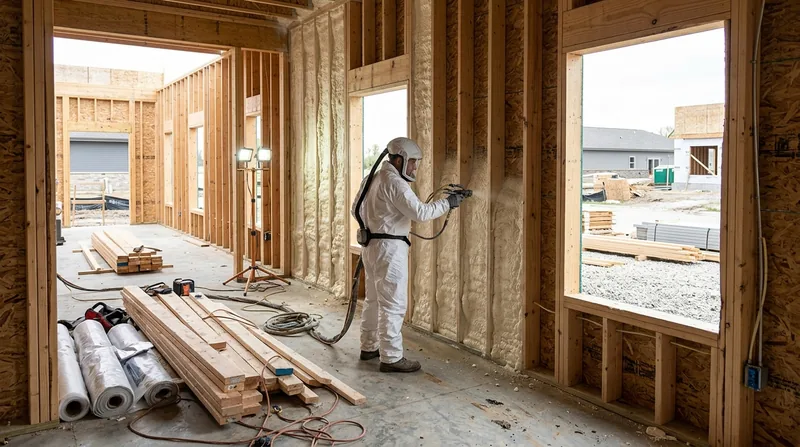




Commercial & New Construction Spray Foam in Cedar Rapids is specified early in framing, before drywall closes the walls in. Builders across Linn and Johnson counties rely on foam to seal attics, walls, and rim joists during the construction phase, when access is open and the building envelope can be sealed tight before mechanical systems are installed. Cedar Rapids spans more than a century of building stock, from early-1900s structures near downtown and Czech Village to postwar ranches and new subdivisions spreading through Marion, Hiawatha, and Robins. New construction in these areas sits over basements rather than crawl spaces, which means rim joists and band joists are critical thermal boundaries. Spray foam applied during framing prevents the air leaks and thermal bridging that plague basements and rim areas in this cold, humid climate zone 5A. Getting foam in place before drywall also means no wall cavities left guessing, no voids above top plates, and no settling or compression over time. We work with builders to spray foam commercial shells, new residential framing, and mixed-use projects before the building closes up.
Why Commercial & New Construction Spray Foam Matters in Cedar Rapids
Cedar Rapids and surrounding areas experience hard winters and humid summers in climate zone 5A. During the heating season, warm, moist indoor air is pushed outward through the building envelope by pressure differences. Any air leak at the ceiling plane, at rim joists, or through wall penetrations allows that moisture-laden air to escape into cold framing, where it condenses and can cause rot, mold, and structural damage over time. Foam applied during construction closes these paths before they become problems. Builders specify foam early because it seals the thermal boundary, controls air leakage, and prevents the thermal bridging that occurs at rim joists and band joists over basements. New construction also allows the installer to work to specification without demolition, salvage, or the constraints of occupied spaces.
- Seals attic framing and the ceiling plane before drywall goes up, eliminating air leaks that would otherwise persist for the life of the building.
- Closes rim and band joists over basements, the highest-heat-loss zone in Cedar Rapids homes and the point where condensation damage is most likely in winter.
- Fills wall cavities in new framing without demolition, ensuring no voids or settling that would reduce R-value over time.
- Provides a continuous air barrier that reduces heating load and prevents moisture intrusion into wall cavities and attic framing.
- Allows builders to meet or exceed code energy requirements and reduce callbacks for thermal comfort and condensation issues.
Specifying foam during construction is the most cost-effective way to build an airtight, durable envelope in this climate.
Key info: New construction projects in Marion, Hiawatha, and Robins often include sealed attics and rim joist foam as standard practice. Builders who specify foam during framing avoid the retrofit costs and complexity of air sealing existing homes, and they reduce the risk of moisture damage at rim joists and band joists, the zones where condensation is most damaging in Iowa winters.
For more context on how foam seals the building envelope, see our page on air sealing in Cedar Rapids.
How We Work on Commercial & New Construction Projects in Cedar Rapids
Our process begins with the builder's framing plan and energy code requirements. We meet on site during the open-frame stage, measure the spaces to be insulated, and provide a written estimate that specifies R-value, foam thickness, and square footage. Once the job is scheduled, we coordinate with the general contractor to spray foam attics, walls, rim joists, and any other thermal boundaries before drywall or mechanical work begins. During application, we control drum temperature, maintain the manufacturer's spray ratio, and apply foam in controlled passes to achieve the specified thickness without over-packing. Mechanical ventilation is run during cure to manage off-gassing, and we provide a re-entry window of twenty-four to forty-eight hours before drywall or other trades resume work. After cure, thermal barriers and ignition barriers are installed per code, and we provide documentation of the work completed.
- Meet on site during open framing to review the scope, measure cavities, and understand the builder's energy and code requirements.
- Provide a written estimate with R-value, thickness, and square footage so the builder knows exactly what will be installed and where.
- Schedule the spray during a window that fits the construction timeline, coordinating with other trades to avoid delays.
- Apply foam to specification using controlled temperature, proper drum ratio, and mechanical ventilation during cure.
- Install thermal and ignition barriers per the building code in force at your address and verify with the local building official.
- Provide documentation of the work, including photos, R-value data, and thickness records for the builder's compliance file.
Our role is to close the thermal envelope so the builder can move on to mechanical, electrical, and finish work with confidence that the building is airtight and insulated to spec.
Local example: A new residential subdivision in Robins or a mixed-use commercial shell in Cedar Rapids requires rim joist foam, sealed attic foam, and wall cavity fill before drywall. We spray to the builder's specification, control the cure environment, and provide the documentation the building official needs to sign off on the energy code compliance. The job is done before mechanical trades arrive, so no schedule conflicts and no re-entry issues.
For details on how closed cell and open cell foam compare in new construction, see our closed cell spray foam page.
Spray Foam Methods for Commercial & New Construction
| Approach | Description | Best for |
|---|---|---|
| Closed Cell Spray Foam | High-density foam with an R-value of 6 to 7 per inch. Forms a rigid, vapor-closed barrier that resists moisture and air infiltration. Applied in controlled passes to achieve the specified thickness. | Rim joists, band joists, basement walls, and sealed attics where moisture control and air sealing are critical. Also used in metal buildings and barndominiums where condensation on steel is a risk. |
| Open Cell Spray Foam | Lower-density foam with an R-value of 3.5 to 4 per inch. Soft, permeable, and allows moisture vapor to pass through. Lighter on framing and easier to trim after cure. | Attic cavities and wall cavities in new construction where cost is a factor and moisture vapor permeability is acceptable. Provides good air sealing at a lower material cost than closed cell. |
| Injection Foam in New Walls | Foam injected into wall cavities during framing before drywall is installed. Fills the entire cavity without voids or settling, ensuring consistent R-value across the wall. | New wall framing in residential and commercial construction where cavities are open and accessible. Eliminates the need for batt insulation and reduces air leakage at wall-to-foundation and wall-to-roof interfaces. |
| Attic and Roof Deck Foam | Closed cell or open cell foam applied to the underside of roof decking or to the attic floor framing before roof sheathing is installed. Creates a sealed, insulated attic or vented space as specified by code. | New residential and commercial construction where a sealed attic or conditioned attic space is desired. Prevents air leakage at the ceiling plane and eliminates the need for soffit vents if a sealed attic is specified. |
Commercial & New Construction Spray Foam Cost in Cedar Rapids: What to Expect
The cost of spray foam on a new construction or commercial project depends on the foam type, the area to be insulated, access, and the R-value or thickness specified by the builder. A free commercial estimate is the starting point. We measure the attic framing, rim joists, wall cavities, and any other zones to be sealed, and we provide a written quote that breaks down the square footage, R-value, and cost. Factors that affect the final price include the complexity of the framing, whether the space is open and accessible or requires special rigging, the choice between closed cell and open cell foam, and the thickness required to meet the builder's energy code compliance. New construction projects often benefit from the open-frame access, which keeps labor costs lower than retrofit work where walls must be demolished or cavities accessed from the exterior.
- Closed cell foam costs more per board foot but provides higher R-value and moisture resistance, making it the choice for rim joists and basements in Cedar Rapids cold climate.
- Open cell foam is less expensive per board foot and is often used for attic insulation and wall cavities where cost efficiency is important and vapor permeability is acceptable.
- Access and framing complexity drive labor cost. A simple attic with clear floor framing is faster to spray than a cathedral ceiling or a complex roof deck with multiple planes.
- Getting two or three estimates from different contractors ensures you understand the market rate and can compare scope, R-value, and warranty terms.
For a detailed pricing overview and to schedule your free estimate, visit our pricing page or call us at (319) 774-1583.
What to Look for When Hiring a Spray Foam Insulation Contractor Near Cedar Rapids
Finding the right spray foam contractor for a commercial or new construction project requires more than a low bid. The installer must understand the building code in force at your address, provide a detailed written estimate with R-value and thickness specifications, and have insurance that covers the work. Permitting and contractor registration vary by city across Greater Cedar Rapids, and there is no reciprocity between jurisdictions, so always verify what applies at your specific address and confirm that the contractor you hire is registered with the local building department if required. Check references from other builders or property managers, ask to see documentation of previous jobs, and understand the warranty and re-entry timeline before work begins. Avoid contractors who promise immediate re-entry, who cannot explain the difference between closed cell and open cell foam, or who offer a price far below market without a detailed scope. The strongest signal of a competent installer is a written estimate that names R-value, thickness, and square footage, and that explains the cure process and re-entry window clearly.
- Verify that the contractor is fully insured and that the insurance covers spray foam application and the curing process on your project.
- Request a written estimate that specifies R-value per inch, thickness in inches, total square footage, and the type of foam (closed cell or open cell) being used.
- Ask about the mechanical ventilation plan during cure and the re-entry window, which should be twenty-four to forty-eight hours for most commercial projects.
- Confirm with your local building department which permits and contractor registration are required at your address and verify the contractor's compliance before signing a contract.
- Check references from other builders or commercial property managers who have used the contractor on similar projects in Cedar Rapids or Marion.
For help finding a qualified contractor in your area, contact us for a free estimate and a conversation about your project scope.
Commercial & New Construction Spray Foam in Cedar Rapids: Pricing Guide
| Service | Price | Details |
|---|---|---|
| Free Commercial Estimate | Free | On-site measurement and written quote with R-value, thickness, and square footage for your project |
| Closed Cell Spray Foam | Starting at $1.50 per board foot | High-density foam for rim joists, basements, and sealed attics where moisture control is critical |
| Open Cell Spray Foam | Starting at $0.70 per board foot | Lower-cost option for attic cavities and wall framing in new construction where vapor permeability is acceptable |
| Wall Cavity Injection Foam | Starting at $1.20 per board foot | Foam injected into open wall cavities during framing, filling the entire cavity without voids or settling |
| Thermal and Ignition Barriers | Included in estimate | Installation per local building code requirements, verified with the building official at your address |
| Travel within Cedar Rapids service area | Included | No separate mileage fee or call-out charge for projects in Cedar Rapids, Marion, Hiawatha, and surrounding areas |
Indicative pricing, the exact cost depends on square footage, finish, and site access. Free personalized estimate within 24h at (319) 774-1583.


