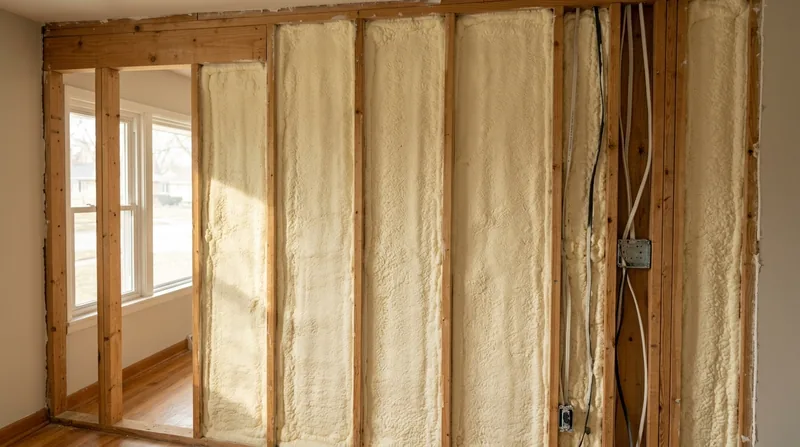




Open cell spray foam insulation in Cedar Rapids fills wall cavities and attic spaces with a flexible, sound-dampening layer that seals drafts while muffling the wind noise Cedar Rapids homeowners know all too well. Built from the early 1900s through today, homes across Cedar Rapids, Marion, Hiawatha, and Robins carry a mix of original framing, post-derecho repairs, and newer construction, each with its own air-leak profile. Open cell foam works where the walls are accessible and where you need both thermal control and acoustic benefit. Unlike closed cell foam, open cell stays softer and absorbs sound, making it the right choice for attic cavities in postwar ranches and for interior wall work where moisture drying is not a concern. We spray open cell at the proper ratio and thickness, control cure conditions with mechanical ventilation, and leave the site clean so you know what you got.
Why Open Cell Foam Matters in Cedar Rapids Homes
Cedar Rapids sits in IECC climate zone 5A, a cold, hard-winter region where heating bills dominate the budget and air leaks at the ceiling plane and rim joists do the most damage. The 2008 flood and 2020 derecho reshaped the housing stock here, leaving many homes with a patchwork of original and repaired framing. Postwar ranches and newer subdivisions in Marion and Hiawatha carry vented attics that still leak heat through recessed lights and penetrations, while older homes near downtown and the Cedar River often have flattened or missing insulation above the top plates. Open cell foam fills these cavities with a continuous air seal, stopping the warm, moist indoor air from escaping into cold framing where it condenses and rots wood. It also dampens the sound of derecho-season wind and attic noise, a quality that matters in homes built close together.
- Seals irregular cavities and around electrical wiring without leaving gaps that fiberglass cannot reach.
- Absorbs sound from wind, rain, and attic movement, reducing noise transfer into living spaces.
- Allows moisture to dry to the interior, so it works in wall cavities where closed cell would trap water.
- Costs less per board foot than closed cell, making it the price-friendly choice for attic top-ups and retrofit walls.
- Cures in place, requiring no settling or compaction over time like blown-in fiberglass does.
Open cell foam is the right answer when you need a thermal and acoustic seal in accessible cavities and when moisture management favors a breathable approach.
Local example: A 1960s ranch in Marion with a vented attic and recessed lights loses heat constantly through the ceiling plane. Open cell foam fills the attic cavity to the target R-value, seals around the lights, and stops the draft. The same homeowner notices less wind noise during storms because the foam absorbs sound in the attic cavity. Cost per board foot is lower than closed cell, and the job is done in a day.
For more on how air sealing works alongside foam, see our air sealing service page.
How We Install Open Cell Spray Foam in Cedar Rapids
Open cell spray foam goes down in thin passes, building to the target thickness and R-value without overspraying or creating voids. We control the spray gun, the ratio of A and B components, and the drum temperature so the foam expands evenly and cures at the right pace. Mechanical ventilation runs during application and for the full cure window, which typically takes 24 to 48 hours before the space is safe to re-enter. We inspect the final thickness and density to confirm the R-value matches the estimate, and we document it in writing so you know what you paid for.
- We assess the cavity depth, width, and any obstructions before we mix the first batch of foam.
- We spray in thin, overlapping passes to fill the space uniformly without gaps or thin spots.
- We maintain mechanical ventilation throughout the cure period to control off-gassing and ensure proper set.
- We measure and document the final thickness and R-value so the job is verifiable and matches the contract.
- We clean up debris and seal the rig before we leave, leaving the site ready for the next trade or for you to occupy safely after cure time.
This discipline is what separates a professional spray foam job from a rig-and-run where nobody is reachable when the smell does not go away.
Real job: A Hiawatha homeowner with a 1970s split-level and an unfinished basement rim joist calls for an estimate. The rim is 18 inches tall, runs 120 linear feet around the basement, and has gaps where the original sill plate has settled. We spray 2 inches of open cell foam to seal the rim and band joist, control temperature at the basement floor, and stop the draft that was making the basement cold. The job takes one day, cure is overnight, and the homeowner re-enters the next morning. Cost starts at the board-foot rate because the cavity is simple and accessible. See our rim joist and band joist page for more detail on this common job.
| Approach | Description | Best for |
|---|---|---|
| Attic cavity fill | Open cell foam sprayed to target R-value in accessible attic cavities, sealed around penetrations and recessed lights. | Postwar ranches with vented attics, homes needing sound dampening, retrofit work where blown-in has settled or failed. |
| Wall retrofit | Injection foam or cavity fill in existing walls without demolition, open cell allows moisture to dry to the interior. | Pre-1980 homes in Cedar Rapids with hollow walls, homes with drafty exterior walls, retrofit without tearing drywall. |
| Rim and band joist | Open cell foam 1 to 3 inches thick seals the basement rim joist perimeter, stops cold floors and drafts at the rim. | Nearly every Cedar Rapids basement, entry-level thermal upgrade, homes with cold floors over basements. |
| Garage ceiling | Open cell foam in garage ceilings buffers temperature and sound, seals air leaks from the garage into the home. | Attached garages in Marion, Hiawatha, and Robins, homes where garage temperature affects living space comfort. |
| Crawl space walls | Open cell foam on crawl space rim and rim band, seals perimeter air leaks where the foundation meets the frame. | Homes in Ely, North Liberty, and other areas with crawl spaces, moisture-controlled crawls where closed cell is not needed. |
Open Cell Spray Foam Insulation Cost in Cedar Rapids: What to Expect
Open cell spray foam insulation in Cedar Rapids starts at approximately $0.55 per board foot, plus labor and any prep work needed to ready the cavity. A typical attic top-up of 500 to 800 board feet runs $275 to $440 in material, plus labor and mobilization. A rim joist around a 1,500-square-foot basement might be 200 to 400 board feet, depending on depth and length. The final cost depends on the cavity size, depth, accessibility, whether old insulation must be removed first, and the complexity of the layout.
Factors that move the price up include cavities that are hard to reach, work that requires scaffolding or lifts, removal and disposal of failed foam or fiberglass before the new foam goes down, and any structural repairs needed before we spray. If the substrate is wet, moldy, or contaminated, we stop and refer you to the appropriate specialist. We do not spray over problems we cannot fix.
Get detailed pricing for your specific job by calling (319) 774-1583 for a free estimate. We measure on site, account for access and prep, and give you a written number with R-value and thickness specs. Comparing 2 to 3 estimates from fully insured contractors is smart because spray foam quality depends on technique, not just material cost.
Open Cell Spray Foam Insulation Near Me: What Cedar Rapids Homeowners Should Know When Hiring
Finding the right spray foam contractor in Cedar Rapids means checking whether they are fully insured, getting multiple estimates in writing, and understanding what happens before and after the job. A good contractor gives you a written estimate with R-value and thickness specs, not just a price per board foot. They explain what permits apply at your address and how they will handle cure time and ventilation. They answer questions about off-gassing, re-entry windows, and what to expect during and after the spray day.
Bad spray foam work leaves a signature: an estimate with no R-value or thickness, no mention of mechanical ventilation during cure, a promise of immediate re-entry, a price far below market with no inspection afterward, or insurance that cannot be verified. These are the markers of a rig-and-run crew that sprays fast, leaves, and is unreachable when the smell does not clear or when the foam does not cure properly. Ask any contractor you call for proof of insurance and a written workmanship warranty. Verify that they understand the building code in force at your address, because attic ventilation, ignition barriers, and thermal barriers are governed by the energy and building code, not by the contractor.
- Confirm the contractor is fully insured and ask for a certificate of insurance before work begins.
- Get a written estimate that includes R-value, thickness in inches, and board-foot count so you can compare apples to apples.
- Ask whether the contractor will handle or help coordinate any required permits for your city or HOA.
- Verify that the contractor will use mechanical ventilation during cure and state a re-entry window of 24 to 48 hours in writing.
- Check references from recent jobs in Cedar Rapids, Marion, or Hiawatha so you can talk to homeowners about their experience.
Contact us at cedar-rapids-spray-foam.com/contact or call (319) 774-1583 for a free estimate with no obligation.
Open Cell Spray Foam Insulation in Cedar Rapids: Pricing Guide
| Service | Price | Details |
|---|---|---|
| Open cell attic insulation | Starting at $0.55/board ft | Typical attic top-up of 500 to 800 board feet, sealed around recessed lights and penetrations |
| Rim joist and band joist sealing | Starting at $0.55/board ft | 200 to 400 board feet per basement perimeter, depth and length determine final volume and cost |
| Wall retrofit and injection foam | Starting at $0.55/board ft | Existing cavities without demolition, volume varies by wall length, height, and cavity accessibility |
| Garage ceiling insulation | Starting at $0.55/board ft | Attached garage cavities, cost depends on ceiling height, area, and whether old insulation must be removed |
| Insulation removal and replacement | On estimate | Removal cost depends on volume and condition of failed foam or fiberglass before new foam is installed |
| Free estimate | No charge | Written estimate with R-value and thickness specs, response within 24 hours at (319) 774-1583 |
Indicative pricing, the exact cost depends on square footage, finish, and site access. Free personalized estimate within 24h at (319) 774-1583.


