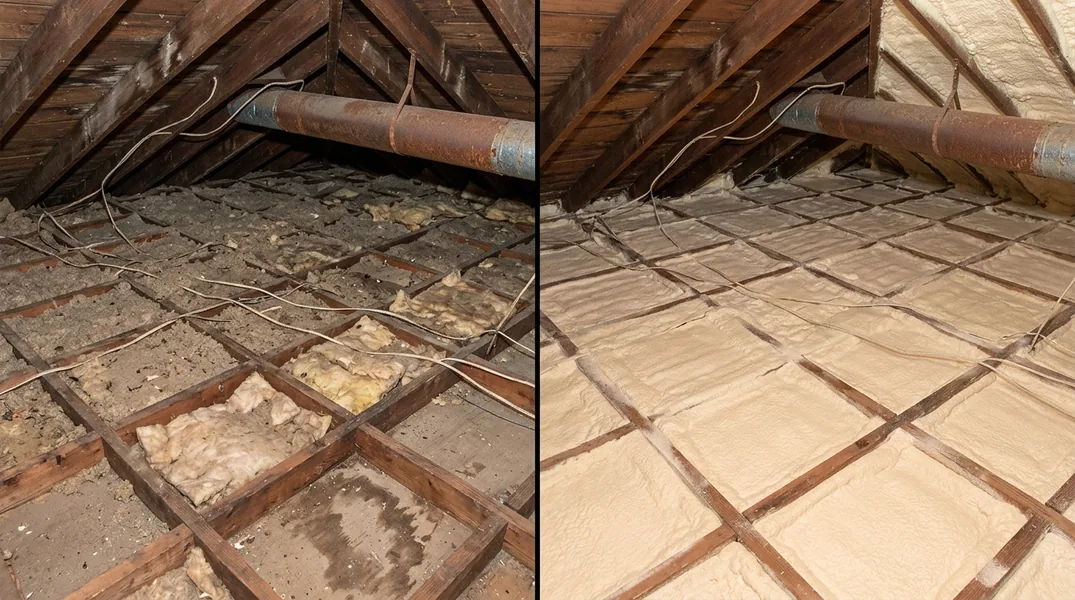
Understanding Postwar Ranch Homes and Their Insulation Challenges
Postwar ranch homes built between the 1940s and 1970s represent a significant portion of residential architecture across Cedar Rapids, Marion, and Hiawatha. These single-story homes were designed with efficiency in mind, but their insulation standards fall dramatically short of modern building codes and energy requirements. Most postwar ranches were originally insulated with fiberglass batts, mineral wool, or sometimes nothing at all in the attic spaces. Over the past 50 to 80 years, this insulation has settled, deteriorated, and lost much of its thermal resistance.
The challenge with aging postwar ranch homes is that their attic spaces often feature irregular framing, multiple penetrations for plumbing and electrical systems, and awkward joist configurations that make traditional insulation methods ineffective. Homeowners in these properties frequently experience significant temperature swings between seasons, higher-than-average utility bills, and moisture problems that lead to mold and structural damage. If you own a postwar ranch in the area, upgrading your attic insulation is one of the most impactful investments you can make toward comfort and energy savings.
Spray Foam vs Blown-in Insulation: Which Is Better for Your Attic?
When comparing spray foam versus blown-in insulation, the differences in performance and longevity are substantial. Blown-in insulation, typically made from cellulose or fiberglass, is installed by blowing loose fibers into attic cavities using pneumatic equipment. While blown-in insulation is less expensive upfront, it settles over time, loses R-value as it compresses, and offers minimal air sealing properties. This means that even after installation, air leaks around electrical outlets, ceiling fixtures, and wall penetrations continue to compromise your home's thermal envelope. In postwar ranches where attic layouts are often chaotic, blown-in insulation simply cannot reach and seal all the gaps effectively.
Attic Spray Foam Insulation expands to fill every cavity, crack, and void in your attic space, creating an airtight seal that blown-in materials cannot match. Spray foam adheres to framing members, pipes, and wiring, preventing air infiltration at the source. Unlike blown-in insulation, spray foam does not settle or compress over time, maintaining its R-value for the life of your home. For homeowners in Cedar Rapids seeking the best insulation for attic spaces, spray foam delivers superior thermal performance and durability that justifies the higher initial investment.
Spray Foam vs Fiberglass: Why Modern Homes Need Better Solutions
Fiberglass batts were the standard insulation choice for postwar ranch homes, and many still contain the original material installed decades ago. Fiberglass insulation works by trapping air within glass fibers, but it has several inherent limitations. Fiberglass batts require proper installation with no gaps or compression to achieve their rated R-value. In practice, this rarely happens. Gaps around electrical boxes, inconsistent placement, and compression from settling all reduce effectiveness. Additionally, fiberglass does nothing to stop air leakage, which accounts for 25 to 40 percent of energy loss in older homes.
Spray foam insulation outperforms fiberglass in nearly every measurable way. Open Cell Spray Foam Insulation provides an R-value of approximately 3.6 per inch while simultaneously sealing air leaks. Closed Cell Spray Foam Insulation delivers even higher R-values around 6 to 7 per inch and adds moisture resistance, making it ideal for attics prone to condensation. Fiberglass offers only R-3.2 to R-3.8 per inch with zero air sealing capability. For postwar ranches where energy efficiency directly impacts heating and cooling costs, spray foam is the superior choice.
Spray Foam vs Cellulose: Comparing Two Popular Attic Insulation Options
Cellulose insulation is made from recycled paper treated with fire retardants and has gained popularity as an eco-friendly alternative to fiberglass. Like blown-in fiberglass, cellulose is installed pneumatically and offers moderate R-values around R-3.6 per inch. However, cellulose shares the same fundamental weakness as other blown-in materials: it settles significantly over time, sometimes losing 15 to 20 percent of its initial R-value within the first few years. Cellulose also absorbs moisture readily, which can lead to mold growth and degradation in humid climates. In attics where moisture control is critical, cellulose presents genuine risks to both insulation performance and home health.
Spray foam insulation addresses these concerns comprehensively. Because spray foam expands and hardens in place, it never settles or compresses. Open cell spray foam allows some moisture vapor to pass through, preventing moisture trapping, while closed cell spray foam creates a vapor barrier that actively repels moisture. For postwar ranch homes in Marion and Hiawatha where seasonal humidity fluctuations are common, spray foam provides the moisture management and long-term stability that cellulose cannot match. The initial cost difference is offset by the extended lifespan and superior thermal performance of spray foam over 30 or more years of ownership.
Best Insulation for Attic: Why Spray Foam Wins in Postwar Homes
When evaluating the best insulation for attic applications in postwar ranch homes, several criteria matter most: thermal resistance, air sealing capability, moisture management, longevity, and adaptability to irregular spaces. Spray foam excels in every category. The material's expansive nature allows it to conform to the unique framing patterns and obstacles found in older attics, ensuring complete coverage where traditional batts or blown-in materials leave gaps. This comprehensive coverage directly translates to lower heating and cooling costs, improved comfort throughout your home, and reduced strain on HVAC systems.
Another advantage of spray foam is its ability to address air leakage at the source. Energy audits consistently show that air infiltration through attic bypasses is one of the largest sources of energy waste in older homes. Spray foam seals these bypasses permanently, creating a continuous thermal barrier that prevents conditioned air from escaping. Homeowners who upgrade to spray foam often report noticeable improvements in comfort, reduced drafts, and utility bills that drop by 15 to 30 percent depending on the scope of the project. For anyone living in a postwar ranch and serious about improving energy efficiency, spray foam insulation is the most effective solution available.
Attic Spray Foam Insulation Cost in Cedar Rapids: What to Budget
Understanding spray foam insulation pricing is essential for homeowners planning an attic upgrade. The cost of spray foam installation depends on several factors, including attic square footage, the type of spray foam selected (open cell or closed cell), existing insulation removal requirements, and accessibility of the space. Open cell spray foam typically costs between $1.50 and $2.50 per board foot, while closed cell spray foam ranges from $2.50 to $4.00 per board foot. For a typical postwar ranch attic of 1,200 to 1,500 square feet, homeowners can expect total project costs between $3,000 and $8,000 depending on material choice and complexity.
While spray foam represents a larger upfront investment than blown-in insulation or fiberglass, the return on investment is compelling. Energy savings typically offset the installation cost within 5 to 10 years, and spray foam maintains its performance for 30 years or more. Additionally, many homeowners qualify for federal energy efficiency tax credits that can reduce out-of-pocket expenses. To understand your specific situation and receive an accurate estimate tailored to your home, contact Cedar Rapids Spray Foam Insulation at (319) 774-1583 to schedule a free estimate. Our team will assess your attic, discuss your goals, and provide transparent pricing for your project.
Getting Professional Attic Spray Foam Insulation Near Me: Why Local Expertise Matters
Installing spray foam insulation in postwar ranch homes requires specialized knowledge, proper equipment, and certification. This is not a DIY project. Professional installers understand how to work safely in confined attic spaces, manage ventilation requirements, apply foam at the correct thickness, and ensure compliance with local building codes. Cedar Rapids Spray Foam Insulation brings decades of experience working on homes throughout the region, including postwar ranches in Marion, Hiawatha, and surrounding communities. Our team knows the specific climate challenges of the area, understands how older homes respond to different insulation approaches, and delivers results that maximize comfort and energy savings.
When you choose a local company, you benefit from ongoing support, warranty coverage, and the ability to address any questions after installation. Spray foam is a permanent upgrade that will serve your home for generations, so selecting the right installer is crucial. We recommend scheduling a consultation with Cedar Rapids Spray Foam Insulation to discuss your attic insulation needs. Call us at (319) 774-1583 or visit our website to request a free estimate. We'll evaluate your postwar ranch, explain your options, and help you make an informed decision about upgrading your attic insulation.
Looking for a professional spray foam insulation contractor in Cedar Rapids? Cedar Rapids Spray Foam Insulation responds fast for all your spray foam insulation needs.
Get a Free Quote